

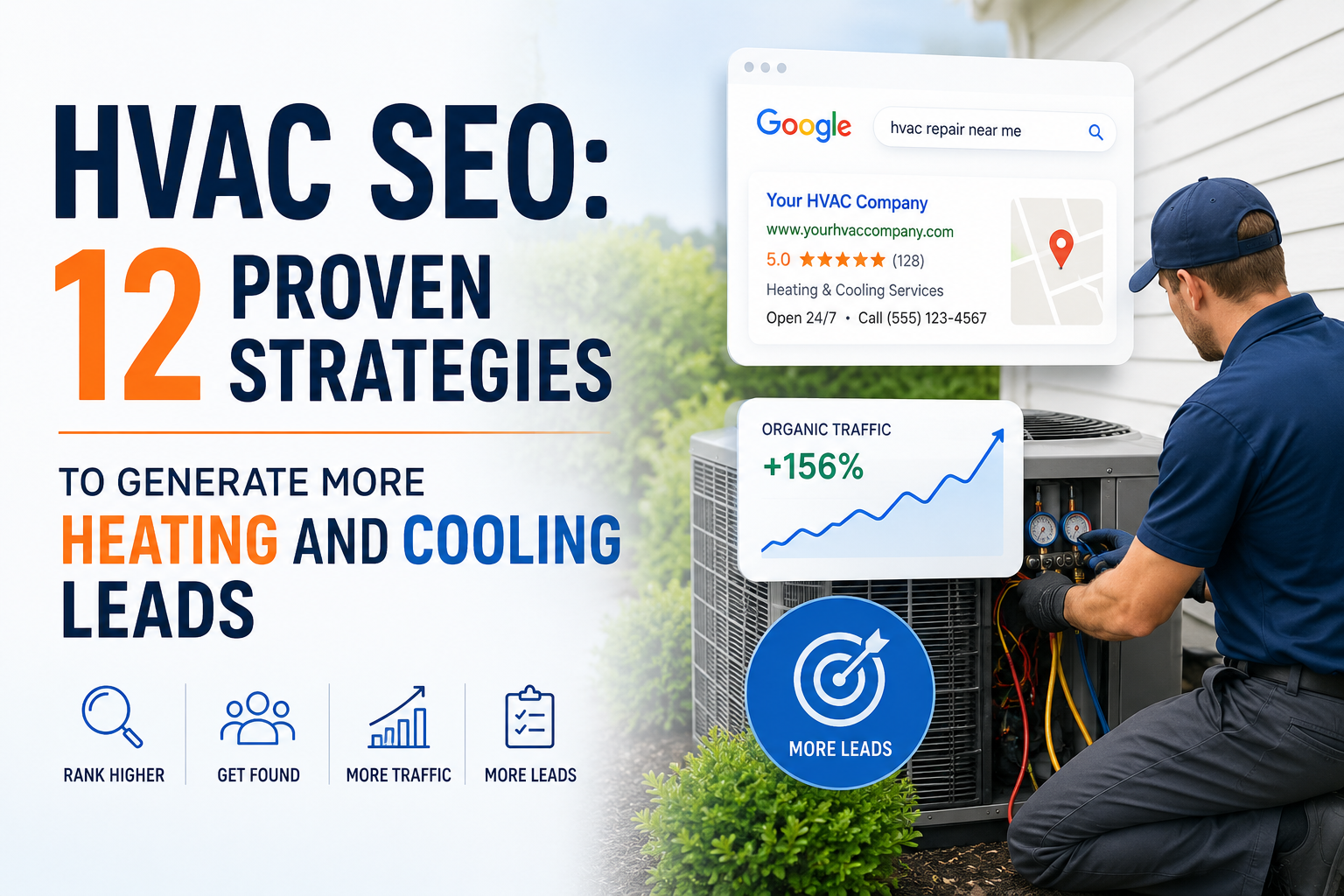
Here is something most HVAC contractors already know but rarely say out loud. You can be the best technician in your city and still lose jobs to someone half as skilled, simply because they show up on Google and you do not. That is the reality of how people find contractors today. A homeowner with a broken furnace at 11 pm is not asking neighbours for recommendations. They are searching, clicking the first result, and calling. HVAC SEO helps ensure your business is the one they find first.
These 12 strategies are what actually separate contractors with full schedules from those waiting on the next call.
1. Get Your HVAC Keywords Right From the Start
There is a real difference between keywords that bring visitors and keywords that bring customers. "Air conditioning" gets searched. "Emergency AC repair near me" gets calls. Focus your targeting on HVAC keywords that carry intent, the kind of phrases people type when something is broken, and they need it fixed today.
2. Treat Your Google Business Profile Like a Second Website
So many contractors set this up once and forget about it. That is a mistake. Google maps rankings are often where the most valuable local calls come from. Keep your categories accurate, your hours current, and your photos real and recent. A neglected profile is a missed opportunity every single day.
3. Stop Relying on One Page to Rank Everywhere
Your homepage cannot do everything. If you serve eight towns, you need eight pages built specifically for those towns. Each one needs its own content, its own local references, its own reason to exist. This is the foundation of local SEO for HVAC companies that actually scales.
4. Fix the Basics of On-Page SEO
Title tags, headers, meta descriptions, internal links, and page speed. None of this is exciting. All of it matters. HVAC website optimization comes down to making it easy for Google to understand what each page is about and who it serves. Skip this, and better-organized competitors take rankings you should own.
Need more local customers to find your business online?
5. Get Ahead of Seasonal Search Trends
Cooling searches spike before summer. Heating searches climb before winter. Most contractors react after demand peaks. Publishing the right content and targeting the right seasonal keywords a few weeks early puts you in front of customers before your competitors even realise the season has shifted.
6. Build Pages Specifically for Emergency Searches
Someone searching "emergency HVAC repair" or "24-hour furnace service" is not browsing. They are about to call someone. Emergency HVAC searches convert at a higher rate than almost anything else in this industry. If your site has no page targeting these terms, you are handing those leads to whoever does.
7. Clean Up Your Local Citations
Your business name, address, and phone number show up in dozens of directories across the web; if those details are a bit different from one place to another, Google just loses confidence in your listing. Keeping everything clean and consistent with local citations is not really glamorous work; it’s more like slow background effort that, over time, quietly lifts your local rankings.
8. Build Backlinks That Actually Mean Something
A single link from your local business association, a supplier’s actual site, or even a regional home improvement blog, is worth more than like a hundred links from random directories nobody ever visits. With HVAC backlinks, it’s really more about that relevance and the kind of trust you’re signaling, not raw volume. Try to focus on the sources that actually make sense for your industry and your area, too, rather than anything that just “exists” online.
9. Answer the Questions Your Customers Are Already Searching
"How often should I service my AC?" "Why is my furnace making that noise?" People search for answers before they search for contractors. Blog content that answers these questions pulls in organic traffic, builds credibility, and puts your name in front of homeowners months before they need to book a job.
10. Your Website Needs to Work on a Phone
Most HVAC searches happen on mobile. If your site loads slowly, looks broken on a small screen, or buries the phone number three scrolls deep, people leave. HVAC website optimization in 2025 means fast load times, a clean mobile layout, and a click-to-call button that is impossible to miss.
11. Reviews Are Part of Your SEO Strategy
Reviews affect where you rank in the map pack and how many people call after finding you. Ask every happy customer directly. Respond to every review, including the difficult ones. This is contractor marketing that keeps working long after the job is closed.
12. Partner With an Agency That Actually Knows HVAC
A generalist SEO agency will learn your industry on your budget. An HVAC SEO agency already understands how seasonality works, how homeowners search, and what it takes to rank in competitive local markets. HVAC marketing has its own logic, and working with someone who already knows it saves time and money.
Conclusion
None of this is complicated, but it does take consistency. The contractors ranking on page one today started this work months or years ago. The ones starting now will be those contractors six months from now. At Red Minstrel Marketing, we do this every day for hvac SEO clients who are done watching competitors take calls that should be theirs. If your business is not showing up where customers are searching, let us fix that.
Ready to turn more Google searches into booked jobs?
Frequently Asked Questions
Why is SEO important for HVAC companies?
When something breaks, people search before they do anything else. If your business does not appear in those results, the call goes to whoever does. HVAC SEO puts your company in front of local homeowners at the exact moment they are ready to hire someone. It is one of the most cost-effective forms of contractor marketing available, and Red Minstrel Marketing helps HVAC businesses get there without guesswork.
How can HVAC businesses rank in Google Maps?
Google Maps rankings come down to a few things working together. A fully completed and accurate Google Business Profile, consistent local citations across directories, a strong volume of genuine reviews, and proximity to the person searching. For most HVAC contractors, the map pack drives more direct calls than organic listings, which makes it a priority in any serious local SEO for HVAC companies strategy.
What keywords should HVAC contractors target?
The ones that convert best are specific and urgent. Seasonal terms tied to heating and cooling cycles also perform well when targeted at the right time of year. Broad terms drive traffic. Specific, intent-driven HVAC keywords drive booked jobs. That distinction is what shapes a strategy worth investing in.
How much does HVAC SEO cost?
Honestly, it depends on how competitive your market is, and also how much real ground needs to be covered. A lot of HVAC contractor SEO campaigns usually land in that range from a few hundred to a few thousand dollars each month, so there’s that. If the city is more competitive, then the cost to rank climbs; it’s just the way it goes. A focused HVAC SEO agency tends to place that budget in the areas that actually generate the most return, instead of stretching it thin across a bunch of tactics that don’t really move the needle.
What is the ROI of HVAC SEO?
Unlike paid ads, organic rankings and map listings keep generating leads without a cost per click. A single well-optimized page can bring in consistent calls for years. Contractors who invest in
HVAC marketing SEO long-term typically see their cost per lead fall well below what paid channels deliver. It builds slowly, but the compounding effect makes it one of the strongest returns available in
HVAC lead generation.
Author Bio :
Red Minstrel Marketing, helping businesses improve their online presence through results-focused strategies. Our expertise spans SEO, website development, local marketing, social media, advertising, and AI-powered marketing solutions designed to drive visibility, qualified leads, and business growth.
Related Post


